
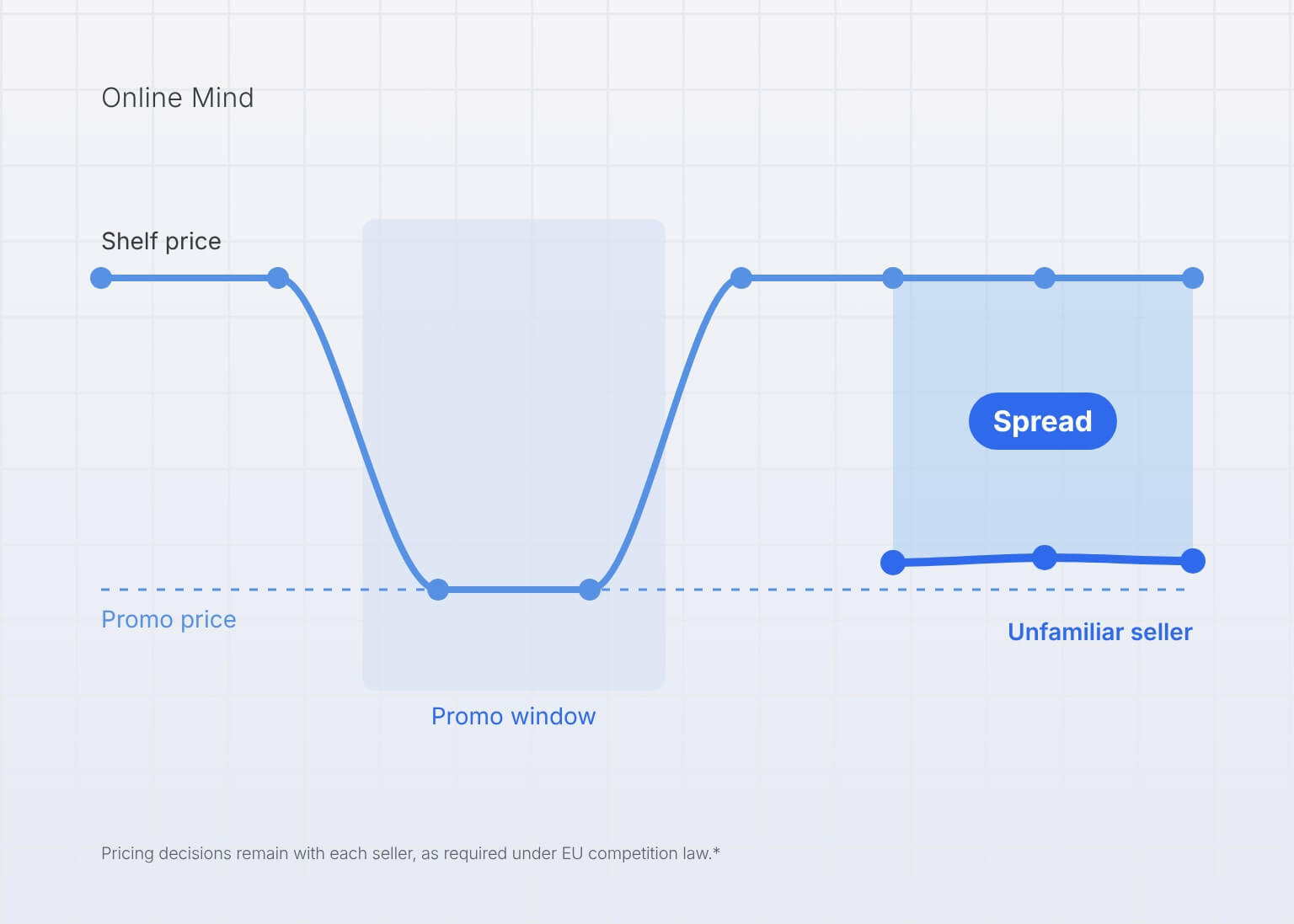
TL;DR: A deep promotion can hand a reseller enough margin to buy at your promo price and resell elsewhere at a profit. This piece works through the spread behind that trade, the signals that show it after a promo, and the levers a brand has in its own promo design.
A brand sets recommended promo prices and support levels for its partners ahead of a big shopping event. Sell-through a week later looks healthy. Three weeks after the promos end, the same SKU turns up on a marketplace barely above the promo floor, sold by an account nobody recognises. The campaign hit its volume target and left a resale trade behind it. Both outcomes came out of the same promotion, and the usual dashboard shows one of them.
The math a reseller runs is short. Buy at the promo price, sell at or near the normal market price elsewhere, keep the difference after marketplace fees and fulfilment. A deep discount widens that gap, which makes the trade more attractive and lowers the reseller's interest in whether the brand meant the stock to move that way.
The fee side is public. Amazon's referral fee schedule on Amazon.de runs category by category, roughly 2% to 45%, with most general merchandise in the high single digits to mid-teens plus a per-item minimum; sellers on Fulfilment by Amazon add storage and per-unit fulfilment charges. eBay's commercial-seller model charges a category-based final value fee plus a flat €0.35 per order, rising to €0.45 above €10, and nothing extra for fulfilment when the seller ships themselves. Two cost structures, and a reseller picks whichever channel leaves more of the spread intact.
The resale channel carries real volume. Germany's Federal Cartel Office found in its 4 February 2026 decision against Amazon's price-control practices on amazon.de that roughly 60% of German online retail revenue on goods runs through amazon.de, and roughly 60% of what sells there comes from independent third-party sellers. A promotion that creates a profitable spread hands it to a channel holding most of a category's online volume. [INTERNAL LINK: Channel monitoring dashboard]
Watch where the stock ends up, rather than how quickly it sold. A grey-market or arbitrage listing is genuine product moving through a channel the brand did not plan for. That sets it apart from counterfeiting, and anyone watching only for fakes will miss it. Brand-protection researchers describe the common pattern: a reseller buys promotional, clearance or overstock inventory and relists it just under the authorised channel, often with automation that catches the discount window as it opens.
Three signals deserve attention in the weeks after a promo. A new or unfamiliar seller turns up on a SKU that normally has a stable seller list. A price on another marketplace or country site sits slightly above your promo floor, where you would expect your shelf price. Volume on that listing follows the promo window instead of your normal demand pattern. Any one of them alone proves little; together and close to the promo date, they justify a closer look.
Monitoring answers the question. The EU's Digital Services Act obliges marketplaces to know their business sellers and to act on illegal listings, and that covers counterfeits and unauthorised claims. A seller observed at a low price sits outside that scope, and a brand has no basis to move against them on price alone. Strategic price intelligence in the DACH region covers what that practice looks like in Germany, Austria and Switzerland.
The decisions here belong to the brand's own promo design. Resale prices stay with the sellers. Two levers sit with the brand from the start: the recommended promo price, and the support behind each partner for that window, whether co-funding, marketing budget or extra stock allocation. Both are unilateral calls taken before the promo runs.
Each of these steps is the brand's own decision about its own promotion, made without reference to what any single seller charges.
Arbitrage risk from a promo is one symptom of a pattern that runs across a catalogue: margin leaking through channels nobody was watching, found weeks later instead of planned around. Treating each case as a one-off fire keeps a team reactive. Building the resale-spread check into promo approval, and the aftermath review into how the next promo gets planned, turns a recurring surprise into a normal part of the promo calendar. Protecting your brand's value proposition looks like exactly that in practice: a calendar your own team designed deliberately, down to the promo depth.
A promotion is an input into someone else's resale math, and a brand can size that input before committing to a price. If you want to see this exposure on your own upcoming promotions before they run, a first call takes thirty minutes and needs nothing prepared from your side.
Pricing decisions remain with each seller, as required under EU competition law. Online Mind's monitoring data is used exclusively to inform each brand's own strategy and is never shared with, or used to influence, individual sellers.