The challenges

Three visibility gaps brand manufacturers face

Most brand manufacturers know their products are listed across many platforms. Few have a clear, current picture of exactly who is doing the listing, on which platforms, and how that landscape is changing from week to week.
Integration icon

Limited visibility into your distribution landscape

Rapid changes across multiple platforms make it difficult to maintain a consistent overview of who is representing your products and where. Key question: what does your digital distribution landscape look like right now?
Integration icon

Unmanaged entities in your channel

Sellers outside your authorised network are active across many European platforms. Without continuous monitoring, their presence is invisible until it becomes a commercial issue. Key question: how many unmanaged sellers are currently active across your digital landscape?
Integration icon

Data that arrives too late

Manual market research produces a snapshot, not a live view. By the time a channel report is produced, the landscape has already shifted. Key question: how many commercial decisions are being made on incomplete or outdated data?
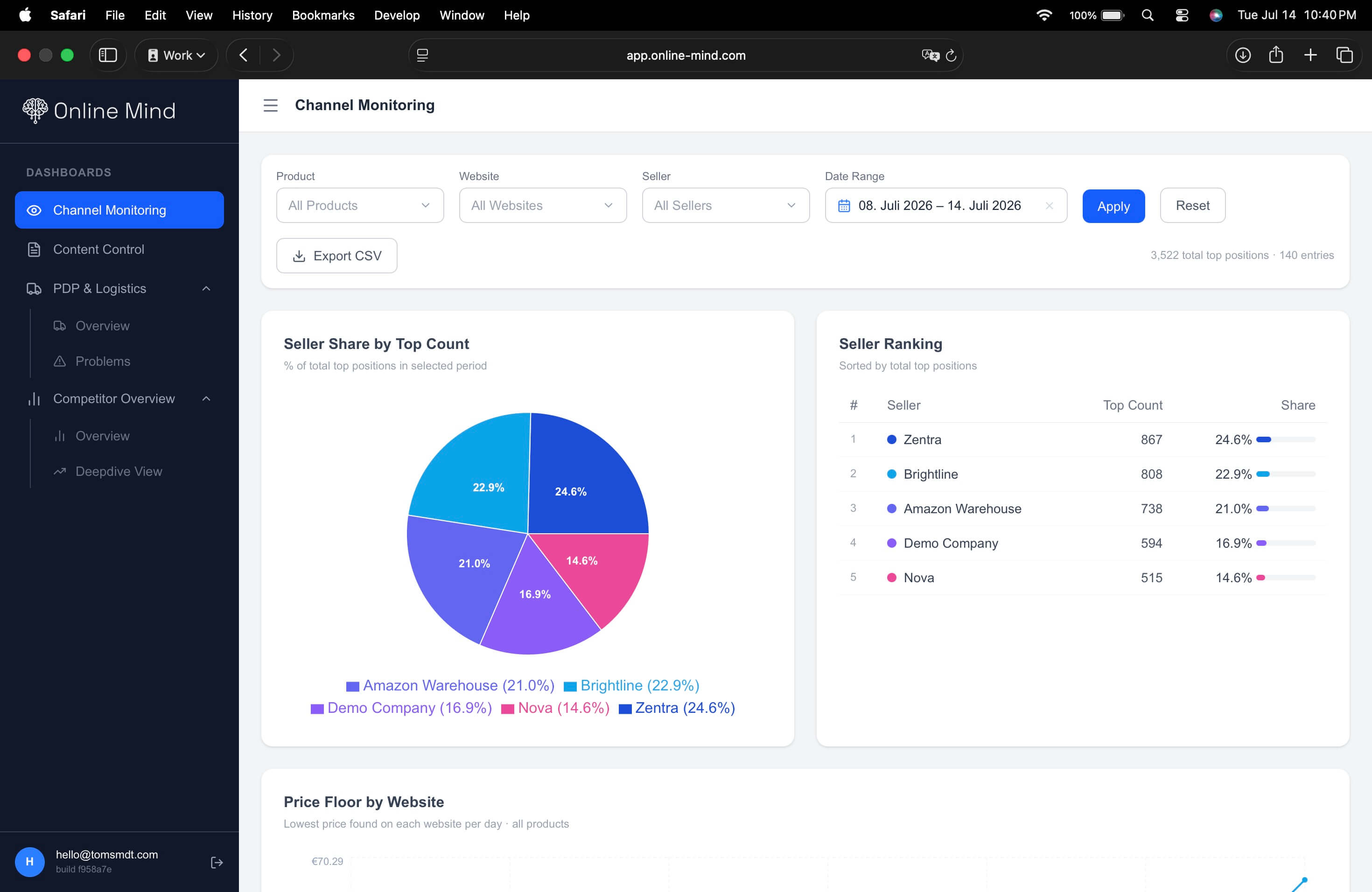
Dashboard mockup
How it works

Most Frequent Lowest Priced Seller, across every platform you sell on

Select one or more products and a timeframe. Online Mind surfaces every seller active across your monitored platforms, including grey market and unmanaged sellers, and drills down to the question that actually matters: who sits alone at the lowest price, and how often.

MFLS counts a seller only when their seller and website combination is strictly and solely the lowest priced offer at that moment. Tied minimums count for nobody. That distinction matters: listing frequently is not the same as setting the floor. We built Online Mind to help brands understand what their brand is really worth in the market, and the seller who repeatedly sets the floor is the one shaping that. Imagine what understanding this means for your margin.
Both views update at the frequency you choose, without manual research and without logging into each marketplace separately. Pricing decisions remain with each seller, as required under EU competition law.
Grey market response

From an unusual listing to a resolved case, in five steps

When Online Mind surfaces a listing or seller pattern outside your authorised network, here is the path most teams follow toward a resolution, at their own pace and under their own judgement.

1

Detect

Online Mind flags an offer or listing pattern that falls outside your known distribution network.

2

Classify

You assess whether the seller is an authorised partner operating more broadly than expected, a legitimate parallel importer, or genuinely unmanaged.

3

Verify

A test purchase or platform check confirms the product's origin and where the seller is sourcing from.

4

Escalate

Confirmed cases are routed to the appropriate channel, whether a marketplace brand-protection programme such as Amazon's Vero, or your own legal process.

5

Resolve

The case is logged and monitoring continues, building a record of how your distribution landscape changes over time.

Every step in this process is a judgement call made independently by your team. Online Mind surfaces the pattern. It does not instruct sellers on pricing or take enforcement action on your behalf. Pricing decisions remain with each seller, as required under EU competition law.

What channel monitoring covers

Your entire distribution landscape, in one place

Configured to your portfolio, your platforms, and your update frequency. Built to show you what your brand is worth in the market, not just who is listing it.

Seller activity and lowest price frequency across European marketplaces

Online Mind tracks every seller active on your products across Amazon, MediaMarkt, Fnac, Bol.com, Currys, Best Buy and other marketplaces and retailer platforms worldwide. Beyond who is present, you see who holds the lowest priced position most frequently, per platform and across your whole portfolio. Presence tells you the shape of your distribution. MFLS tells you where the pressure on your brand value is coming from. Pricing decisions remain with each seller, as required under EU competition law.

Unauthorised seller detection on Amazon, Idealo, and beyond

Any seller not present in your authorised partner list is visible in the Online Mind dashboard the moment they appear. You see their platform
presence and activity data alongside your authorised partners.You have the information to assess the situation and decide how to proceed.
All subsequent decisions remain with you.Pricing decisions remain with each seller, as required under EU competition law.

Cross-border distribution monitoring across DACH and Europe

Distribution networks rarely stop at one border. Online Mind tracks selleractivity across DACH — Germany, Austria, Switzerland — and wider Europeanmarkets including Benelux, Italy, and beyond.Cross-border activity is visible in the same dashboard as domestic listings,so you have a single, coherent picture of your distribution landscaperegardless of how many markets you operate in.

Channel monitoring data in management-ready reports

Raw data is only useful when it informs decisions. Online Mind translatescontinuous monitoring data into clear management reports — delivered onyour chosen frequency.Reports highlight what has changed in your distribution landscape,where new sellers have appeared, and which areas of your channelrequire attention. Every recommendation reflects publicly observedmarket data, not assumptions.
The rest of the platform

Channel monitoring is one part of a bigger picture

Online Mind brings distribution, competitive pricing, and product content together from the same underlying data. Explore the rest of the platform.

Content Control

See how your product listings score across every marketplace, and where content quality is quietly costing you conversions.

See content scoring →
Competitor Overview

Track how your prices compare to named competitors, platform by platform, over time.

In development
PDP & Logistics

Monitor product page health and fulfilment signals across your distribution network.

In development
FAQ

Common questions about channel monitoring

Got questions about how Online Mind works, what it covers, and whether it's right for your business? Here are the ones we hear most often.

What is channel monitoring for brand manufacturers?

Channel monitoring for brand manufacturers gives brands real-time visibility into who is selling their products across online marketplaces and retailer platforms, how seller activity is distributed across channels, and where listings fall outside the authorised partner network. It is distinct from media monitoring, which tracks brand mentions and sentiment, and from retailer-facing pricing tools, which help sellers optimise their own commercial position. Channel monitoring serves the brand manufacturer's need to understand their own distribution landscape — not to manage or influence what individual sellers do within it. Online Mind is a channel monitoring platform built specifically for brand manufacturers operating under European competition law. It observes and presents publicly available market data. All commercial decisions based on that data remain the brand manufacturer's own, independent judgement. Pricing decisions remain with each seller, as required under EU competition law.

How does channel monitoring work across European marketplaces?

Online Mind continuously scans active listings across Amazon, MediaMarkt, Otto, Idealo, Galaxus, Fnac, Darty, Bol.com, Coolblue, Unieuro, El Corte Inglés, Allegro, Elgiganten, Currys, Best Buy and more. For each product in your portfolio, the platform maps which sellers are active, on which platforms, and how often — updated on the cadence you define. You see your entire distribution landscape in one dashboard, including which sellers hold the lowest priced position most frequently. The view updates automatically. No manual checks. No separate logins per marketplace. No reliance on partners to report their own activity. Coverage is extended to match your distribution landscape, and cross-border monitoring across Europe is included as standard. Pricing decisions remain with each seller, as required under EU competition law.

What is the difference between channel monitoring and brand protection software?

Brand protection tools focus on IP enforcement — detecting counterfeits and filing takedowns via marketplace programs such as Vero on eBay. They are designed to identify and remove infringing listings. Channel monitoring is a broader intelligence layer. It maps who is active in your distribution landscape, how sellers are distributed across platforms, and which listings fall outside your authorised partner network — without taking any enforcement action itself. Online Mind provides the market intelligence for your own independent decisions. If you identify a listing that warrants further investigation, the appropriate next step — whether a commercial conversation, a legal action, or simply continued monitoring — remains entirely with you. Learn about content monitoring

How do I identify unauthorised sellers on Amazon and Idealo?

Online Mind continuously scans active listings across European platforms. Any seller not present in your authorised partner network is visible in the dashboard alongside their platform activity data — the moment they appear. You see their presence across platforms, how frequently they list, and how their activity compares to your authorised partners. That gives you the information to assess the situation and decide how to proceed. All subsequent commercial or legal decisions are yours. Online Mind does not flag sellers as problems, take enforcement actions, or make recommendations about individual sellers. It provides the data — you make the decision. Pricing decisions remain with each seller, as required under EU competition law.

Is channel monitoring compliant with EU competition law?

Yes. Online Mind was built specifically for brand manufacturers operating under European competition law — and EU compliance is a design principle, not a footnote. EU competition law, specifically Article 101 TFEU, places strict limits on any coordination between a brand manufacturer and its resellers regarding pricing. Many monitoring tools were built for retailers or for markets where these rules do not apply in the same form. Online Mind observes and presents publicly available market data. It does not draw conclusions about individual seller pricing decisions, does not provide any basis for coordinating pricing with sellers, and does not make recommendations that could constitute vertical price coordination. All insights inform the brand manufacturer's own independent commercial judgement. Every commercial or legal decision based on Online Mind data remains entirely with the brand manufacturer. Pricing decisions remain with each seller, as required under EU competition law.

Which European marketplaces does Online Mind monitor?

Online Mind monitors Amazon, Idealo, Galaxus, Otto, MediaMarkt, Euronics, and Alternate.de as standard. Coverage can be extended to additional European marketplaces and retailer websites depending on your distribution landscape. Cross-border monitoring across DACH — Germany, Austria, and Switzerland — is included, as is coverage of Benelux and other European markets where your products are distributed. Global marketplace coverage is available for brands operating beyond Europe. Additional platforms are available on request — speak to the team about your specific distribution landscape.

A complete picture of your distribution landscape — always current

Request a demo and see your own products and distribution landscape in the Online Mind dashboard.
We care about your data in our privacy policy.
Thank you! Your submission has been received!
Oops! Something went wrong while submitting the form.