
Knowing a competitor moved their price is not the same as knowing why.
Online Mind tracks competitor price positioning across every platform you sell on, so you can tell a strategic move from a short-term promotion.
Every platform. Every competitor. One place.
How it works
Pick your products. Set your timeframe.
Choose the SKUs and the equivalent competitor products that matter, define the period, and get a structured view of how your products sit relative to the market, by platform and over time.
Our competitiveness KPI condenses that into a single figure, so you can read your position at a glance instead of working through a table. Pricing decisions remain with each seller, as required under EU competition law.
Our competitiveness KPI condenses that into a single figure, so you can read your position at a glance instead of working through a table. Pricing decisions remain with each seller, as required under EU competition law.
Strategic positioning or short promotion
Tracking market prices over weeks and months shows whether a competitor has repositioned or is running a temporary campaign. The two call for very different responses.
Know which SKUs are exposed
The competitor deepdive shows where the gap to the market is widest, per SKU and per platform, before it shows up in your sales figures.
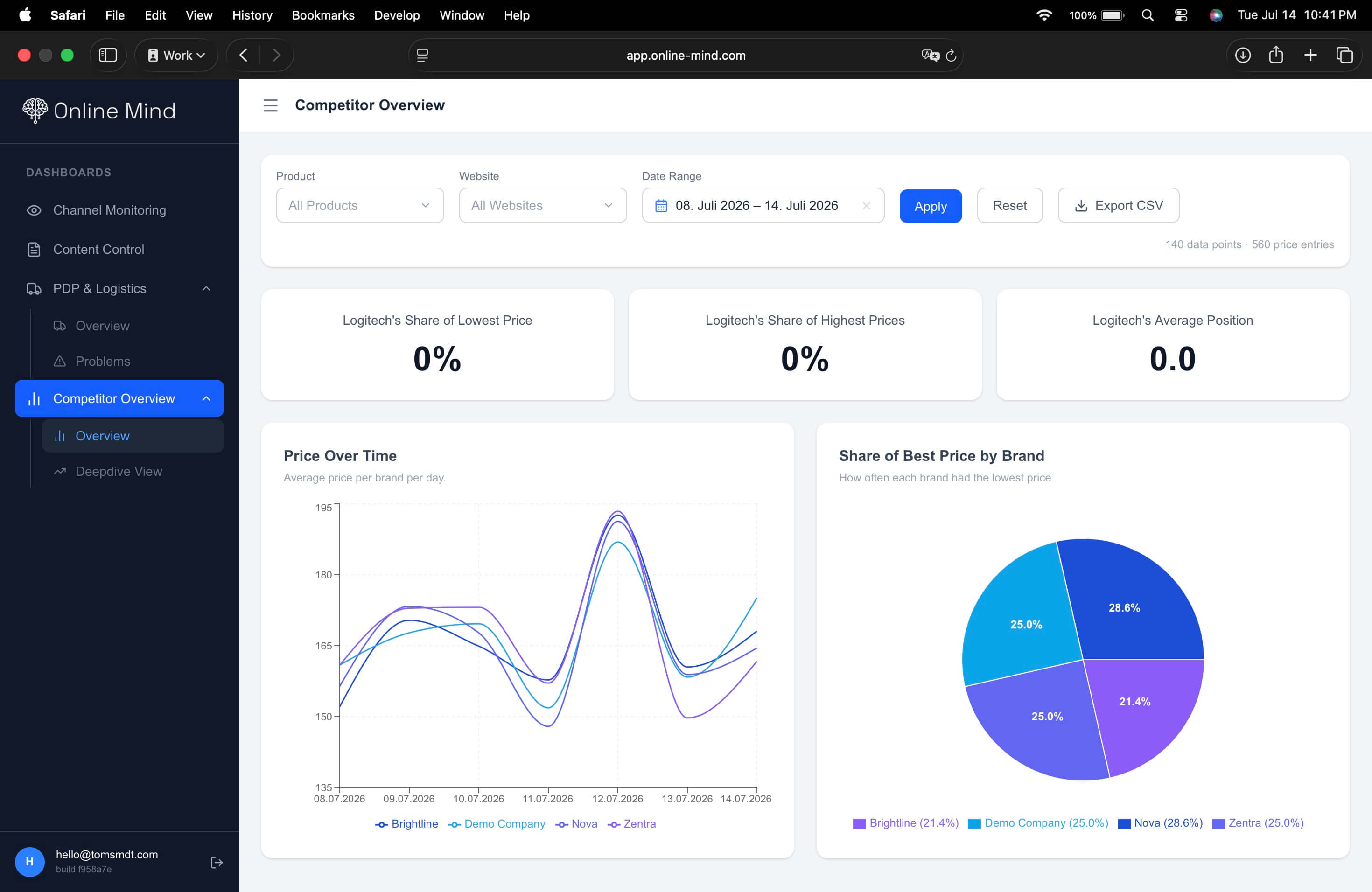
Your competitive position, continuously updated
Best price by day, your rank, and the gap to the lowest priced brand, per product and platform. You see where you lead, where you follow, and how far apart the market really is. Online Mind reports publicly observable market data only. Pricing decisions remain with each seller, as required under EU competition law.
No manual price research
No separate logins per marketplace
Dashboard or spreadsheet export
Get alerted when the market moves
Set your own thresholds. When a competitor crosses them on a product or platform you care about, Online Mind tells you, at the frequency you scan. Pricing decisions remain with each seller, as required under EU competition law.
What we track
The comparisons behind your competitive position.
Price positioning
Where you sit against equivalent products, per platform
Competitiveness KPI
Your competitive position as a single, trackable figure
Strategic vs. promotional
Whether a move is a repositioning or a short campaign
SKU exposure
Which products carry the widest gap to the market
Best price by day
Your price, the best price, and your rank, day by day
Share of best price
How often each brand holds the leading position
Historic trend
Weeks and months of movement, not a single snapshot
Custom criteria
Any additional comparison you need, fully configurable
Competitors tracked across global marketplaces and retailer platforms
AmazonMediaMarktOttoIdealoAlternate.deEuronicsGalaxusFnacDartyCdiscountBol.comCoolblueEl Corte InglésPcComponentesUnieuroAllegroElgigantenPowerCurrysBest Buy
A selection of what we cover. Further marketplaces and retailer websites are added to match your distribution landscape.
Quick Answers
FAQ
Common questions about competitor price monitoring
What is competitor price monitoring for brands?
It tracks how equivalent competitor products are priced across the platforms you sell on, over time rather than as a snapshot. Online Mind structures that into a view of where your products sit relative to the market, per platform and per SKU.
What is the competitiveness KPI?
A single figure describing your position against the competitive set, so you can track movement over time instead of reading a full price table each week. It sits alongside your share of best price and your average rank.
How do you tell a strategic price move from a promotion?
By looking at duration and pattern. A price that returns after a short window behaves like a campaign. A price that holds across weeks and spreads across platforms behaves like a repositioning. Online Mind keeps the history so the difference is visible.
Does Online Mind set or recommend prices?
No. Online Mind shows you publicly observable market data and what it means for your position. Every commercial decision stays with you, and pricing decisions remain with each seller, as required under EU competition law.
How is this different from channel monitoring?
Channel monitoring looks inward at who sells your products and how they behave. Competitor overview looks outward at how rival products are positioned against yours. You can use them independently or together.